Drink driving in Poland 2026: penalties, driving ban and car confiscation from 1.5‰
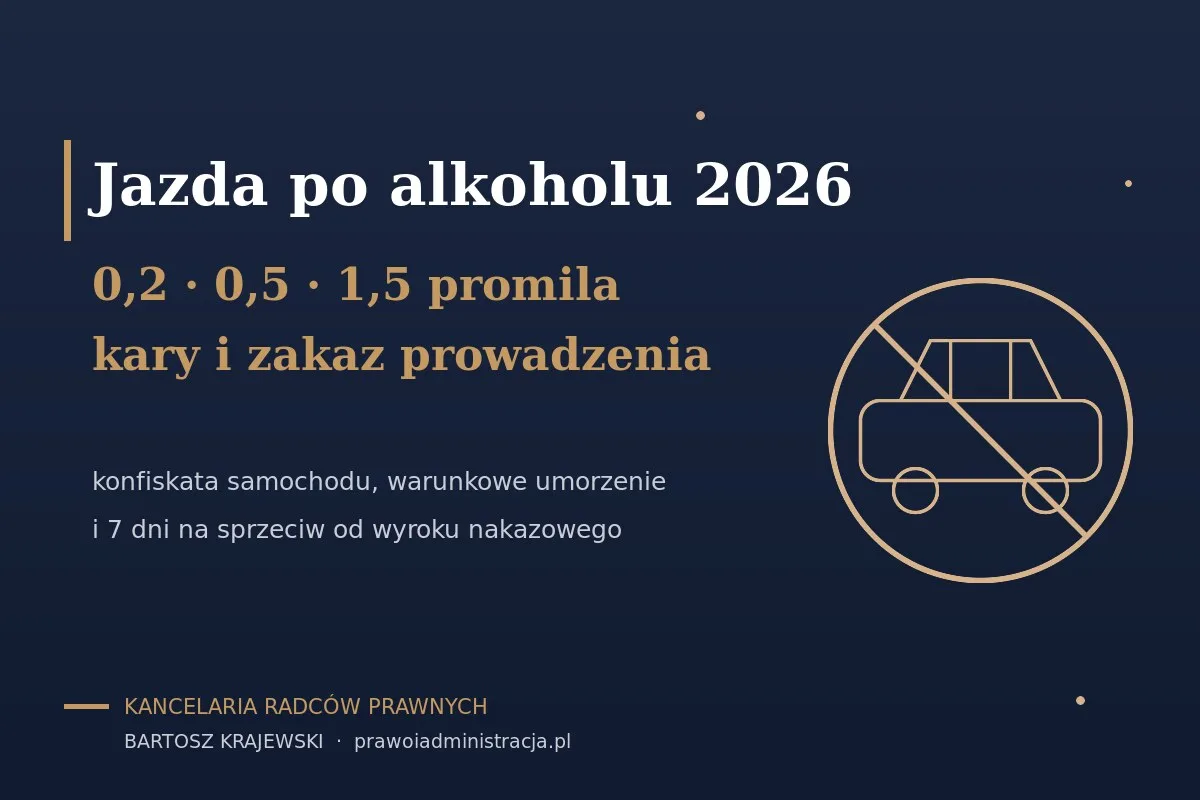
Drink driving in Poland in 2026 is a petty offence from 0.2‰ and a crime above 0.5‰: it carries up to 3 years of imprisonment, a driving ban of at least 3 years, a payment of at least PLN 5,000 and, from 1.5‰, forfeiture of the car. Below is the law as of 20 November 2026: thresholds, penalties, the rules on confiscating the vehicle, the driving ban and the situations in which a court may conditionally discontinue the case. If proceedings have already started and you want a defence lawyer to take over, see criminal defence in Warsaw.
Kancelaria Radców Prawnych Bartosz Krajewski, a law firm in Warsaw, defends drink driving cases across Poland, also remotely and in several languages for drivers from abroad. We step in at the police, prosecutor or court stage, including after a penal order has been served. Pricing is individual, after we review the documents.
0.2‰ and 0.5‰: where the petty offence ends and the crime begins
The legal classification depends on the test result, not on how the driver feels. Polish law uses three thresholds, measured in blood or in exhaled air:
- state after consuming alcohol: from 0.2‰ to 0.5‰ in blood or from 0.1 to 0.25 mg of alcohol per 1 dm3 of exhaled air (art. 46(2) of the Act on Upbringing in Sobriety), which is a petty offence under art. 87 of the Code of Petty Offences;
- state of insobriety: above 0.5‰ in blood or above 0.25 mg per 1 dm3 of exhaled air (art. 115 § 16 of the Criminal Code), which is a crime under art. 178a of the Criminal Code;
- at least 1.5‰ in blood or 0.75 mg per 1 dm3 of exhaled air: from this threshold the court as a rule orders forfeiture of the vehicle (art. 44b § 1a of the Criminal Code).
From 0.2‰ to 0.5‰: a petty offence, but with a mandatory driving ban
Driving a motor vehicle after consuming alcohol is punishable by detention of 5 to 30 days or a fine from PLN 2,500 to PLN 30,000 (art. 87 § 1, art. 19 and art. 24 § 1a of the Code of Petty Offences). The court also imposes a driving ban of 6 months to 3 years and has no discretion here: for this offence the ban is mandatory (art. 87 § 3, art. 29 § 1). The police officer seizes the driving licence during the roadside check, and that period later counts towards the ban. For cycling in a state of insobriety the fine starts at PLN 2,500, and after consuming alcohol at PLN 1,000 (art. 87 § 1a and 2).
Above 0.5‰: the crime under art. 178a of the Criminal Code
Driving a motor vehicle in a state of insobriety or under the influence of an intoxicating substance is a crime punishable by up to 3 years of imprisonment (art. 178a § 1). The court does not stop at the penalty itself. A driver with no previous convictions has to expect four rulings:
- the penalty: imprisonment of up to 3 years; where it would not exceed one year, the court may instead impose restriction of liberty of at least 4 months or a fine of at least 150 daily rates (art. 37a § 1);
- a driving ban of at least 3 years and at most 15 years (art. 42 § 2, art. 43 § 1);
- a payment to the Victims and Post-Penitentiary Assistance Fund: at least PLN 5,000 and at most PLN 60,000 (art. 43a § 1 and 2);
- forfeiture of the vehicle or a compensatory payment, described below (art. 44b).
Repeat offending is treated far more severely. A person who drives in a state of insobriety after a final conviction for such an act, or during a driving ban imposed for a crime, is liable under art. 178a § 4: from 3 months to 5 years of imprisonment, a payment of at least PLN 10,000 and a lifetime ban on driving all motor vehicles, unless an exceptional case occurs (art. 42 § 3, art. 43a § 3). The court may then suspend the sentence only in particularly justified cases (art. 69 § 4).
Car confiscation from 1.5‰: when the court orders forfeiture of the vehicle
At a concentration of at least 1.5‰ in blood or 0.75 mg per 1 dm3 of exhaled air the court orders forfeiture of the vehicle driven by the offender, unless there is an exceptional case justified by special circumstances (art. 44b § 1a). Below that threshold forfeiture is possible but not mandatory: the court may order it with any conviction under art. 178a (art. 44b § 1).
Forfeiture is not ordered where, at the time of the act, the vehicle was not the exclusive property of the offender, for example it was leased, belonged to the employer or to both spouses, or where forfeiture is impossible or pointless because the car has been sold, lost, destroyed or seriously damaged (art. 44b § 5). In the first case the court orders a payment to the State Treasury of PLN 5,000 to PLN 500,000, in the second it may do so (art. 44b § 6). Ownership documents and the circumstances of the act therefore translate directly into money. Before you give any statement on this point, show the firm the registration certificate and the contract under which you use the car.
The driving ban: when it starts running and when you can drive again
The ban applies from the date the judgment becomes final, but the period for which the licence was seized counts towards it (art. 63 § 4 of the Criminal Code), so every day since the roadside check matters. After at least half of the ban has been served, or at least 10 years in the case of a lifetime ban, the court may allow driving vehicles fitted with an alcohol interlock (art. 182a of the Executive Criminal Code). The application has to show that the driver is no threat to road safety, so it is built on documents, not declarations.
Driving despite a ban is a separate crime punishable by 3 months to 5 years of imprisonment (art. 244 of the Criminal Code), and drink driving during a ban means liability under art. 178a § 4, including the lifetime ban. The conviction cannot be expunged before the ban has been served (art. 107 § 6), which matters for the criminal record certificate required by employers.
Conditional discontinuance: a case without a conviction
For the act under art. 178a § 1 the court may conditionally discontinue the proceedings if the offender has no conviction for an intentional crime and the guilt and social harm of the act are not significant (art. 66 § 1 and 2). The probation period lasts from one to 3 years, the driving ban may then be imposed for no more than 2 years, together with a payment (art. 67 § 1 and 3). This is not a conviction, which matters for employment, professional licences and residence matters. Whether the court uses this solution depends on the circumstances: the alcohol level, the time and place, the distance driven and the driver's life so far. Nobody can honestly guarantee the result, but the motion with evidence has to be filed at the right moment.
Many such cases end with a penal order, issued without a hearing and delivered by post. You have 7 days from delivery to file an objection (art. 506 § 1 of the Code of Criminal Procedure), and after an ordinary judgment 7 days to request written reasons and 14 days to appeal (art. 422 § 1, art. 445 § 1). After these deadlines the judgment becomes final. How to count them is explained in our article interlocutory appeal, objection to a penal order and appeal: deadlines.
Drivers from abroad: a drink driving conviction and your residence permit
For a foreigner the consequences do not end in the courtroom. A final conviction in Poland for an intentional crime, with a fine or imprisonment, is a ground for entry in the register of foreigners whose stay in Poland is undesirable (art. 435(1)(2) of the Act on Foreigners), and a valid entry means refusal of a temporary residence permit (art. 100(1)(2)). No entry is made where the only penalty was a fine and it has been paid (art. 436(1)(3)), so for a foreigner the type of penalty matters as much as its size. Driving in a state of insobriety is an intentional crime. A driver with a residence card, a visa or UKR status should therefore agree a line of defence before accepting a judgment without a hearing. The full path is described in our guide arrested in Poland as a foreigner: the criminal case and your residence permit.
How we handle drink driving cases
We start with the file: the test report, the calibration certificate of the device, the time between the stop and the measurement, and the vehicle documents. On that basis we say plainly what is realistic in the case: conditional discontinuance, a lighter penalty, a shorter ban, or a defence against forfeiture and a high payment. We do not promise a result, because the court decides. We have no price list for criminal cases: pricing is individual, after reviewing the documents, for a specific stage of the case.
The firm's office is in Warsaw at ul. Marszałkowska 20/22 lok. 72, phone 537 927 737, and we handle cases across Poland. Describe your case and send the documents through the page criminal law, contact the firm. Cases are handled by attorney-at-law Bartosz Krajewski.
Law as of 20 November 2026. Legal basis: Criminal Code (art. 37a, 42, 43a, 44b, 66, 67, 115 § 16, 178a, 244), Code of Petty Offences (art. 87), Code of Criminal Procedure (art. 422, 445, 506), Executive Criminal Code (art. 182a), Act on Foreigners (art. 100, 435, 436).
Frequently asked questions
At what alcohol level is drink driving a crime in Poland?
What is the penalty for drink driving in Poland in 2026?
When does the court take the car for drink driving?
For how long do you lose your driving licence for drink driving?
Can a first-time offender avoid a conviction?
I received a penal order for drink driving. What can I do?
I am a foreigner. Will a drink driving conviction harm my residence permit?
Legal basis
- Ustawa z dnia 6 czerwca 1997 r. – Kodeks karnyDz.U. 1997 nr 88 poz. 553
- Ustawa z dnia 20 maja 1971 r. Kodeks wykroczeńDz.U. 1971 nr 12 poz. 114
- Ustawa z dnia 12 grudnia 2013 r. o cudzoziemcachDz.U. 2013 poz. 1650
- Ustawa z dnia 6 czerwca 1997 r. – Kodeks postępowania karnegoDz.U. 1997 nr 89 poz. 555
- Ustawa z dnia 6 czerwca 1997 r. – Kodeks karny wykonawczyDz.U. 1997 nr 90 poz. 557
- Ustawa z dnia 26 października 1982 r. o wychowaniu w trzeźwości i przeciwdziałaniu alkoholizmowiDz.U. 1982 nr 35 poz. 230
Related articles
Arrested in Poland as a foreigner 2026: 48 hours, interpreter, lawyer and your residence permit
Police detention lasts at most 48 hours and the court has a further 24. The rights of a detained foreigner, when remand is likely and what a criminal conviction means for a residence card, permanent residence, citizenship and a return decision.
Read more →
Interlocutory appeal and appeal in a Polish fiscal criminal case — the deadlines with no way back
In fiscal criminal cases the deadlines for challenging a ruling are short and final, and they run from events you can easily miss. What is challenged by what, how much time there is, and what can still be done once the deadline has passed.
Read more →
Reopening a Fiscal Criminal or Criminal Case in Warsaw — When a Finally Concluded Case Can Be Opened Again
A final judgment in a fiscal criminal case is not always the end. Find out when a court can reopen the proceedings, what the deadlines are, and why the motion must be signed by a radca prawny (legal counsel) or advocate.
Read more →
Exchanging a foreign driving licence for a Polish one — who qualifies, what it costs, how long it takes
A foreign driving licence stops working in Poland sooner than most drivers expect — and the issuing country alone decides whether the exchange needs a theory exam.
Read more →