Complaint About the Voivode's Inaction to the WSA — When to File It and What It Costs (2026)
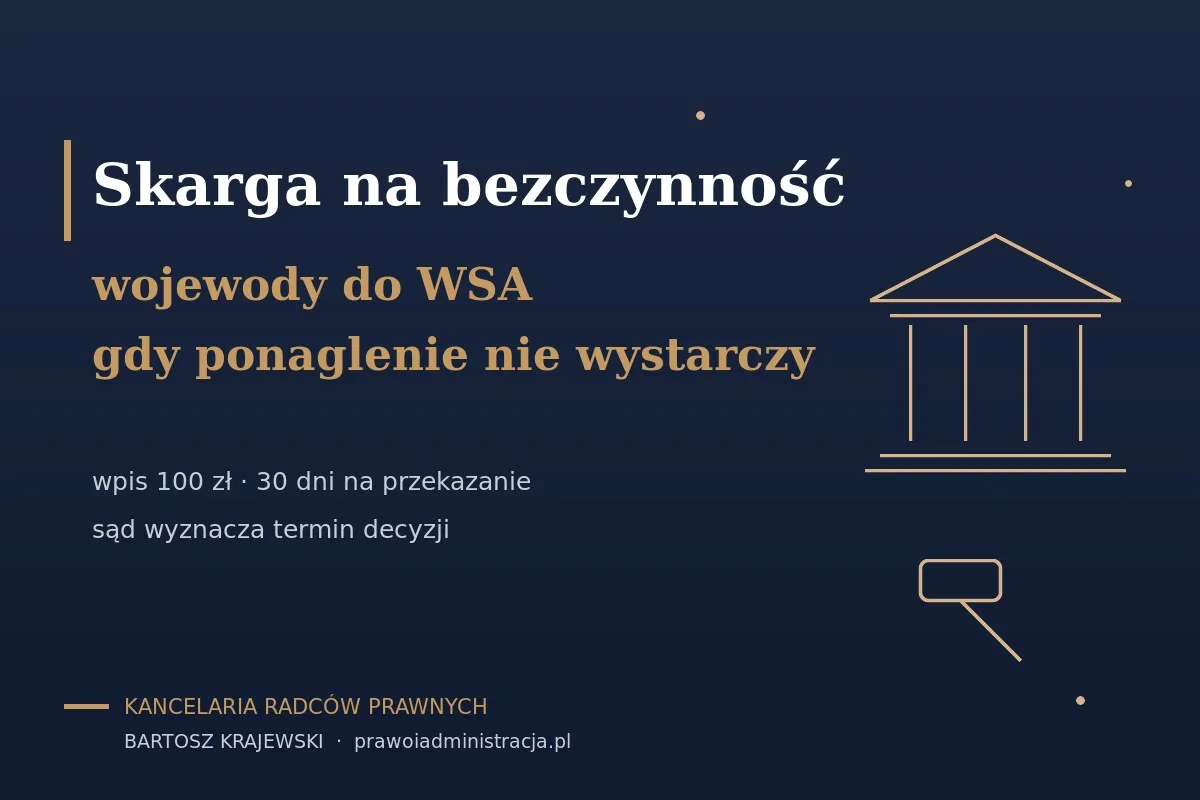
A complaint about inaction is the moment when a court, not the office itself, starts looking at your case. If the voivode has not issued a decision on time and the ponaglenie changed nothing, the voivodeship administrative court can order the voivode to deal with the case by a set date, find a flagrant breach of the law and impose a fine. We handle the ponaglenie and the complaint in one package — see what the 1199 PLN option includes.
When you can file a complaint about the voivode's inaction
There is one condition and no way around it: a ponaglenie must first be filed with the competent authority. After that, a complaint about inaction or protracted proceedings can be filed at any time (Article 53 § 2b of the Law on Proceedings before Administrative Courts) — you do not have to wait for the ponaglenie to be decided, and no deadline can slip past you while the case remains unresolved. A complaint filed without a prior ponaglenie will be rejected. We describe the first step in the article on how to file a ponaglenie in a residence card case.
What the court can do
A complaint about inaction does not decide whether you are entitled to the permit — the court will not issue a residence decision in place of the voivode. It rules on something else: that the authority has stayed silent longer than the law allows. When it upholds the complaint, the court may (Article 149 of the Law on Proceedings before Administrative Courts):
- order the voivode to issue a decision within a specified time,
- find that the inaction or delay amounted to a flagrant breach of the law,
- impose a fine on the authority,
- award you a sum of money payable by the authority.
How the complaint works, step by step
The complaint is not sent directly to the court. The route is longer, but every stage of it works in your favour:
- the complaint is filed through the voivode whose inaction it concerns (Article 54 § 1 of the Law on Proceedings before Administrative Courts); it is heard by the voivodeship administrative court competent for the voivode's seat — for the Mazowiecki Voivode that is the WSA in Warsaw,
- the voivode has 30 days to forward the complaint to the court together with the case files and a response to the complaint (Article 54 § 2),
- within the same period the voivode may itself uphold the complaint in full (Article 54 § 3) — in an inaction case this simply means dealing with the case,
- the court fee for a complaint about inaction is 100 PLN, and where an attorney acts, 17 PLN stamp duty on the power of attorney is added.
Where complaints most often fail
A complaint about inaction is short, but it does not forgive formal mistakes. It usually fails for one of a few reasons: no prior ponaglenie or a ponaglenie filed with the wrong authority, a complaint aimed at “the office” instead of a specific authority, confusing inaction with protracted proceedings in a case where the authority is formally doing something, or a missed court request to pay the fee. Each such mistake costs more weeks, and a voivode who knows the court will not hear the complaint has no reason to hurry. That is why in our cases the complaint is prepared and signed by a legal counsel who handles both steps from the start: the ponaglenie and the complaint.
When a complaint makes sense in a residence case
In a temporary residence permit case the voivode, as a rule, has 60 days to decide (Article 112a of the Act on Foreigners), and in other cases the deadlines of Article 35 of the Code of Administrative Procedure apply. In many voivodeship offices cases take far longer — if yours is months past the deadline and the ponaglenie changed nothing, the complaint is the natural next step. We show real waiting times in the article on how long you wait for a residence card in Warsaw.
Ponaglenie and complaint in one package for 1199 PLN
You do not need to find one person for the ponaglenie and another for the court. You order the ponaglenie + complaint about inaction package for 1199 PLN online: fill in the form, pay, and then sign the power of attorney — with a photo from your phone or an electronic signature. We send the ponaglenie no later than the next business day after we receive the power of attorney, and if there is still no decision, a legal counsel files the complaint with the WSA. The firm covers the 100 PLN court fee and the 17 PLN stamp duty on the power of attorney. No honest lawyer will promise you a decision date — but after the complaint your case stops being one of many in the queue and becomes a case a court is looking at.
Frequently asked questions
Can I file a complaint about inaction without a ponaglenie?
How much does a complaint about the voivode's inaction cost?
Which court does the complaint go to?
Can the voivode issue a decision before the court rules?
Will I get money for the delay?
Can the complaint harm my residence card case?
Related articles

Urging Letter (Ponaglenie) for a Residence Card in 2026 — How to Make the Warsaw Office Decide
The office has been silent for months and the statutory deadline is long gone? You have concrete legal tools: an urging letter (ponaglenie) under Art. 37 of the Code of Administrative Procedure, followed by an inactivity complaint to the administrative court — up to and including a fine for the office and money for you.
Read more →
Ponaglenie to the Head of UdSC — When Your Residence Card Appeal Sits for Months
Appeal sent, and silence from the Head of the Office for Foreigners? Appeal proceedings also have a statutory deadline, and once it passes you can file a ponaglenie — only it goes somewhere other than in the first instance.
Read more →
How Long Does a Residence Card Take in Warsaw? Realistically 6-12 Months, Not One Month
The statutory deadline is one month, or two months in complicated cases. In Warsaw a residence card case realistically takes 6-12 months, and that is not a malfunction, it is the norm. We show how long you really wait for a decision, what shortens that time, what stretches it out, and which legal tools you have when the case stalls.
Read more →
Residence Card Refused in Poland - What Next? Appeal to the Head of the Office for Foreigners and Complaint to the WSA
A refusal is not the end of the case - it is the start of a second stage in which every day counts. We explain how long you have to appeal, when you have to leave Poland and when you do not have to at all, and what can realistically still be saved.
Read more →