How to speed up a work permit in Poland in 2026: 4 ways and 3 myths
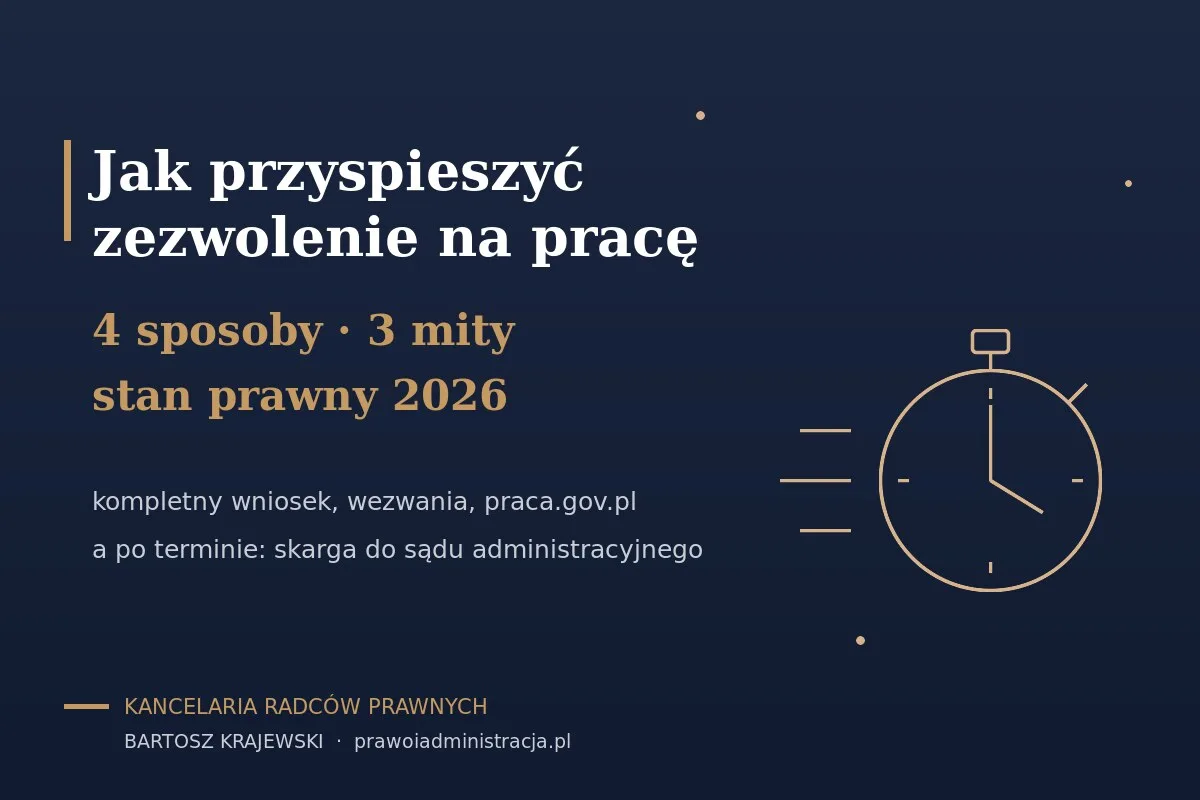
An employer has a real influence on the length of a work permit case in Poland at four points: a complete application with attachments, filing it electronically on praca.gov.pl, answering the office's request within days rather than weeks, and a complaint to the administrative court once the voivode has missed the time limit of Article 35 of the Code of Administrative Procedure. Phone calls to the office, a ponaglenie (formal reminder) and paid “fast-tracking” do not work. Below is the legal position as of 25 November 2026 and data on how long these cases take. If the deadline has already passed, see how we handle a complaint about the voivode's inaction in a work permit case.
Kancelaria Radców Prawnych Bartosz Krajewski, a law firm in Warsaw, helps employers at both stages, remotely and across Poland. Handling a work permit application is quoted individually after we review the documents, and a consultation with a legal counsel (radca prawny) costs PLN 300. Once the voivode has missed the time limit, we file the court complaint for PLN 1199 net (PLN 1474.77 gross) per case; the price includes the PLN 100 court fee and the PLN 17 stamp duty on the power of attorney, and for several applications we agree a package price.
Where the delays come from: 82 days on average in 2025
The law gives the voivode one month, and in a particularly complex case two months from the start of the proceedings, not counting the periods excluded by Article 35 § 5 k.p.a. (Article 35 § 3 k.p.a.). Practice is different. According to the Ministry of Family, Labour and Social Policy, the average length of proceedings in 2025 was 82 days, and 69.5 thousand cases were pending at the end of the year. For type A permits the ministry reported, in its reply to parliamentary question no. 12163, an average of 47 days in 2023 and 98 days in 2024.
In 2026 the queues have not gone away. According to figures of the daily Puls Biznesu from September 2026, quoted by WBJ and in part by Money.pl, the Mazovian Voivodeship Office received about 24.5 thousand applications from January to July 2026 and issued 9.4 thousand permits. The ministry admits that with a mass inflow of applications the waiting time grows even in cases that raise no doubts. The employer has no influence on the pace of the office, but it does on its own part of the case. We collect detailed data in the articles how long you wait for a work permit in 2026 and work permit in Warsaw (MUW).
Way 1: a complete application and attachments the first time
Every defect in the application means a request to cure it within a set time, not shorter than seven days (Article 64 § 2 k.p.a.), and the time for curing does not count towards the office's time limit. A defect not cured on time ends with the application being left unexamined, and the case has to start again. When we handle the application, we check four things before it is sent:
- the employer's and the foreigner's data consistent with the register (KRS or CEIDG) and with the passport, and a current address for service;
- proof of payment of the fee: PLN 200 for a permit of up to 3 months, PLN 400 for a longer one, PLN 800 for a posting;
- pay not lower than that of workers in a comparable position and not lower than the minimum wage (Article 30);
- no arrears in social security contributions and taxes, and an occupation outside the starost's list, because these are grounds for refusal (Articles 13 and 31).
An application for a subsequent permit with the same employer, to continue work in the same position or the same kind of work, is best filed while the current permit is still valid: if it has no formal defects, or the defects are cured on time, work on the terms of the current permit remains legal until the day the decision becomes final (Article 21(1)). The rules and fees are described in our article on the type A work permit in 2026.
Way 2: file electronically, on praca.gov.pl
The 2025 Act introduced full digitalisation: the work permit application and the documents are filed through the IT system (Article 8(2)), and an application filed in any other way is left unexamined (Article 8(3)). Paper sent by post therefore speeds nothing up and only takes the case back to square one. Applications are accepted by the government portal praca.gov.pl.
The office's time limit runs from the day the request reached it (Article 61 § 3 and § 3a k.p.a.), so keep the confirmation of filing: the time limit of Article 35 k.p.a. is counted from that date and that date is later given in the complaint. The ministry says that the adaptation of the systems to the Act will be completed before 31 May 2027, which is meant to shorten the wait.
Way 3: answer the office's request within days, not weeks
The office's time limit does not include time limits laid down for specific steps or delays caused by the party (Article 35 § 5 k.p.a.). Every day a request waits for the employer's answer therefore lengthens the case and weakens a later plea of inaction. Answer at once and in full, in a single letter.
Be careful with corrections filed on your own initiative. The courts take corrections into account: the WSA in Kielce dismissed complaints where the application had been corrected and the decision was issued within two months of filing and shortly after the last correction (judgments of 18 June 2026, II SAB/Ke 52/26 and II SAB/Ke 53/26). An application corrected in instalments is a case that takes longer and is harder to defend in court. How to read the stages of the proceedings is described in our article on the status of a work permit application.
Order of examination and the calendar: what to watch
The Act itself sets the order: the voivode first examines applications from entrepreneurs on the list of companies of significant importance to the economy, then applications for a subsequent permit for the same employer and foreigner on terms no worse than before, next applications concerning occupations on the list of staff shortages, if the minister issues one, and finally all others (Article 27). Priority cannot be bought or begged for, but you can use it by planning the subsequent permit on the same or better terms.
The second thing is the calendar. Note the filing date and the dates of requests and answers. An office that cannot keep the time limit must notify the party, give the reason and set a new time limit (Article 36 k.p.a.). When the time limit passes without a decision, do not wait further months: from that moment the employer may go to court.
Way 4: when the deadline has passed, a court complaint instead of waiting
There is no ponaglenie in work permit cases, so the complaint about inaction or protracted proceedings goes straight to the voivodeship administrative court, through the voivode. The voivode has 30 days to pass the complaint to the court and may also grant it within that time, that is issue the decision (Article 54 § 2 and 3 of the Law on Proceedings before Administrative Courts). Why the ponaglenie does not work here is explained in our article on the ponaglenie in a work permit case.
What do the judgments show? In the 538 judgments of voivodeship administrative courts analysed by our firm and issued between 1 June 2025 and 19 November 2026 (a lower bound, as some rulings have no written reasons yet), the court found inaction or protracted proceedings in 519 cases (96.5%). In 427 of the 538 judgments (79%) the authority closed the case after the complaint was filed and before the judgment; closing the case does not always mean a permit, because there were refusals too, and the data do not show when the decision would have been issued without a complaint. From the day the complaint reached the court to the judgment it took 122 days (median). The court does not issue the permit: it orders the authority to deal with the case. The full data are in our analysis of WSA judgments in work permit cases.
When a complaint makes sense and when it does not
A complaint is not a cure for every delay. The rulings show that the outcome depends on the dates and on whether the application was complete:
- we prepare the complaint when 2 months have passed since a complete application was filed (not counting the time for curing defects), the requests have been answered and there is still no decision;
- it is premature when the time limit is still running or the application was corrected recently: in the analysed set the courts dismissed 19 complaints in full;
- it is too late when the office issued the decision before the complaint was filed; where the office left the application unexamined, what matters is whether it did so rightly;
- it fails on formal grounds when the court fee is missing or formal defects of the complaint are not cured: these are the most frequent reasons for the 114 orders rejecting a complaint.
Three myths about speeding up a work permit
The queues have produced advice that costs time and gives nothing:
- a phone call or a visit to the office: the order of examination follows from the Act (Article 27), and asking about the stage of the case does not change your place in the queue;
- a ponaglenie: it is not available in work permit cases (Article 7(4) of the Act), so it speeds nothing up;
- paid “fast-tracking”: the Act knows no accelerated procedure and no extra fee for faster examination, and the application fee is fixed and does not affect the order.
What the law firm does and what it costs
Handling the application, which is quoted individually, covers checking the basis of employment, the completeness of the attachments and the risks of refusal, and answering the office's requests on the employer's behalf. Once the deadline has passed, a legal counsel prepares the complaint, files it electronically through the voivode and represents the employer before the court. For the complaint we need a scan of the power of attorney, the case number, the filing date and the correspondence with the office. We promise neither a date nor an outcome: the decision is issued by the office, and the court can only order it to deal with the case.
The complaint costs PLN 1199 net (PLN 1474.77 gross) per case; the price includes the PLN 100 court fee and the PLN 17 stamp duty on the power of attorney, and for several applications we agree a package price. An individual quote after a review of the documents and a consultation with a legal counsel for PLN 300 apply to the other services, that is an appeal against a work permit refusal and handling a work permit application.
The firm's office is in Warsaw at ul. Marszałkowska 20/22, suite 72, phone 537 927 737, and we handle cases remotely for employers from all over Poland. Describe the case and send the documents through the page court complaint when the voivode has missed the time limit. Cases are handled by legal counsel Bartosz Krajewski.
Legal position as of 25 November 2026. Legal basis: the Act of 20 March 2025 on the conditions for entrusting work to foreigners in the territory of the Republic of Poland (Journal of Laws Dz.U. 2025 item 621, as amended), the Code of Administrative Procedure and the Law on Proceedings before Administrative Courts (consolidated text Dz.U. 2026 item 143, as amended).
Frequently asked questions
How can you speed up a work permit in Poland?
How long does it take to get a work permit in Poland in 2026?
Can you pay for faster examination of the application?
Will a ponaglenie speed up a work permit?
When can a court complaint about the voivode's delay be filed?
Can the foreigner speed up the work permit case personally?
How much does the law firm's help cost?
Legal basis
- Ustawa z dnia 14 czerwca 1960 r. Kodeks postępowania administracyjnegoDz.U. 1960 nr 30 poz. 168
- Ustawa z dnia 30 sierpnia 2002 r. Prawo o postępowaniu przed sądami administracyjnymiDz.U. 2002 nr 153 poz. 1270
- Ustawa z dnia 20 marca 2025 r. o warunkach dopuszczalności powierzania pracy cudzoziemcom na terytorium Rzeczypospolitej PolskiejDz.U. 2025 poz. 621
Related articles
Ponaglenie in a Polish work permit case 2026: not available, the complaint goes straight to court
The usual advice is: file a ponaglenie first, then go to court. For work permits it is different: the ponaglenie has been unavailable since 2021 and the employer complains about the voivode's inaction to the administrative court straight away, with no ponaglenie first. We explain the provision, the case law and the difference from a residence card.
Read more →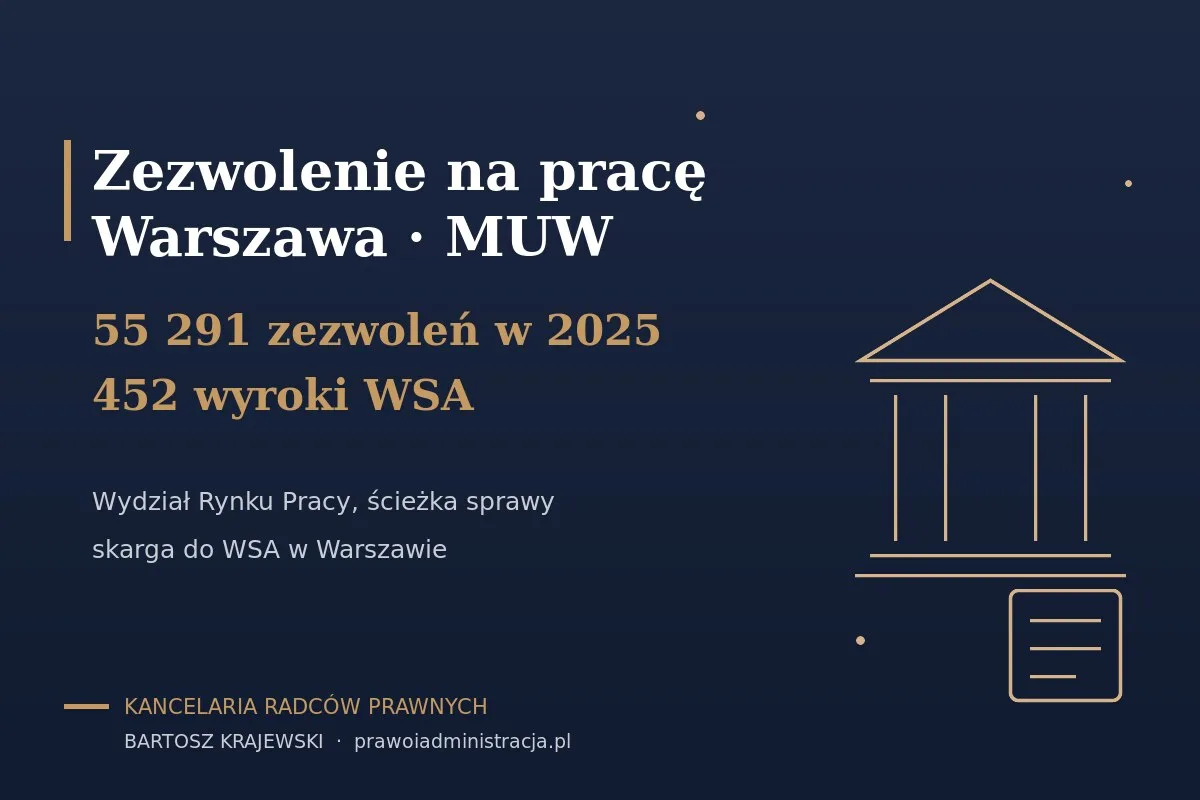
Work permit in Warsaw (Masovian office) 2026: waiting times, how the case runs and a complaint to the WSA
The Masovian Voivodeship Office issues 22% of Poland's work permits and in 2026 it is issuing far fewer. We explain which department handles the case, how the procedure runs, what delay means for an employer and what 452 Warsaw WSA judgments show.
Read more →
Work permit application status in Poland 2026: how to check the case stage and when silence is inaction
You filed a work permit application for a foreign employee and nothing happens? Where to check the stage of the case, what the voivode's requests and notices mean, when the time limit starts and when silence becomes inaction.
Read more →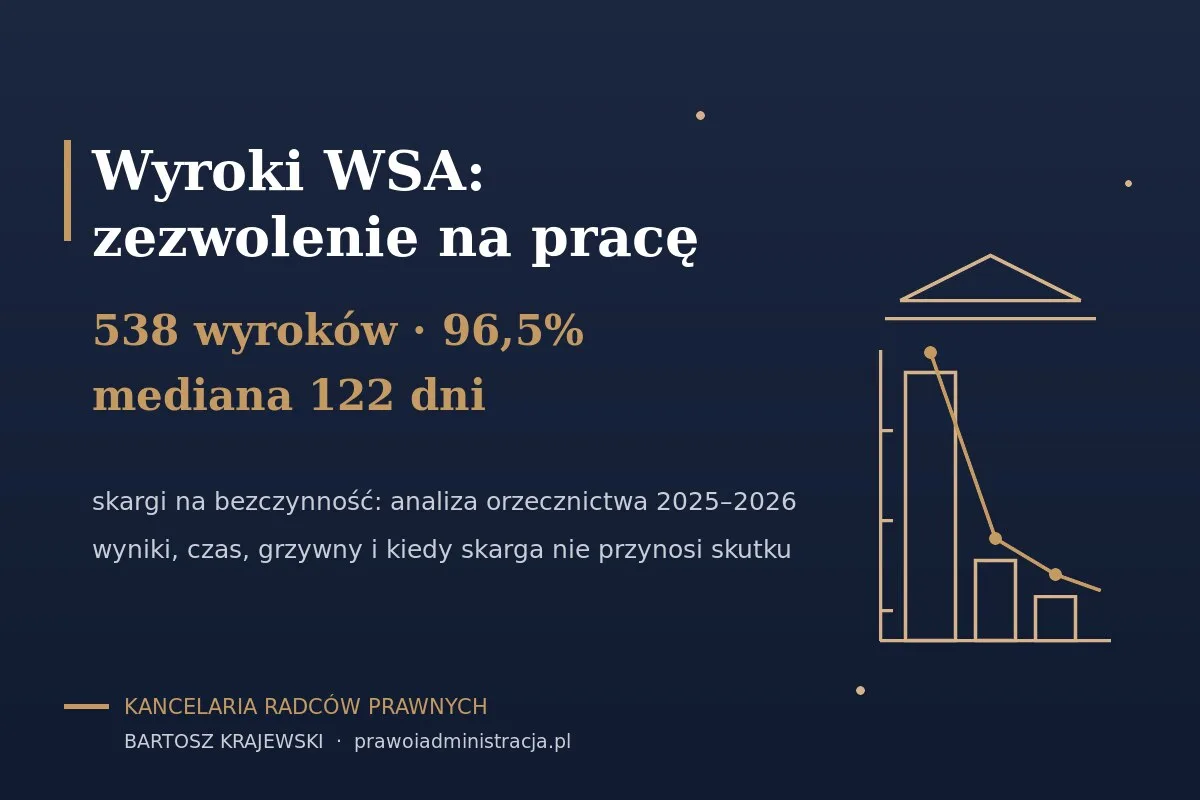
WSA rulings on work permits in Poland: 538 inaction judgments from 2025–2026 in numbers
We analysed 656 rulings of Polish administrative courts on inaction in work permit cases: how often the court finds inaction, how fast a judgment comes and when a complaint brings no result.
Read more →