WSA rulings on work permits in Poland: 538 inaction judgments from 2025–2026 in numbers
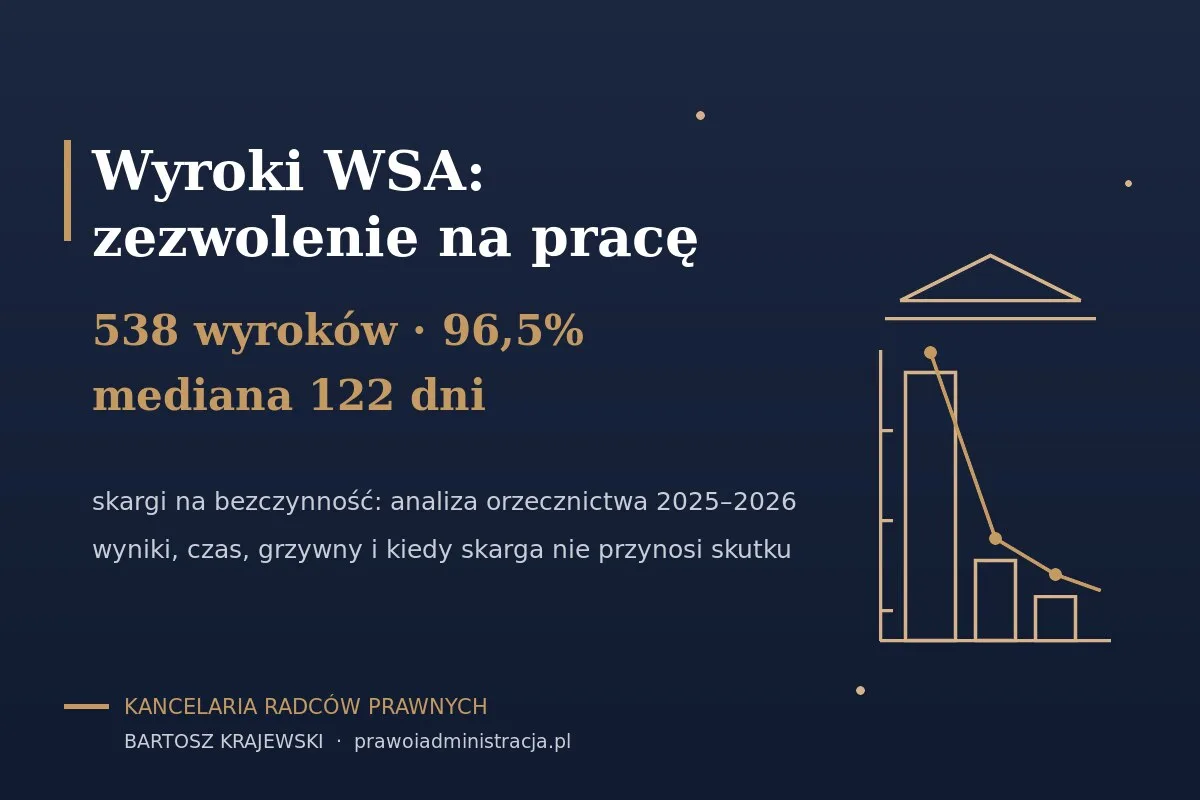
In the 538 judgments of Polish voivodeship administrative courts (WSA) analysed by our law firm, issued between 1 June 2025 and 19 November 2026 on complaints about inaction or protracted proceedings in work permit cases (zezwolenie na pracę), the court found inaction or protracted proceedings on the part of the authority 519 times, that is in 96.5% of cases. In 427 of the 538 judgments (79.4%) the authority closed the case after the complaint was filed and before the judgment; closing the case does not always mean a permit, as there were refusals too. The median time from the complaint reaching the court to the judgment was 122 days, and the court did not award a sum of money to the employer even once. These are the results of a case-law analysis our law firm prepared for its service: complaint about inaction in a work permit case.
Kancelaria Radców Prawnych Bartosz Krajewski, a law firm in Warsaw, files complaints about the voivode's inaction for employers from all over Poland, remotely: 1199 PLN net (1474.77 PLN gross) per case; the price includes the 100 PLN court fee and the 17 PLN stamp duty on the power of attorney; for several applications we quote a package price. Below you will find the full numbers, the methodology and the situations in which a complaint brings no result.
Key numbers from 656 rulings
The data set covers 656 rulings of 9 voivodeship administrative courts: 538 judgments and 118 orders. In 520 judgments the authority was a voivode, in 17 the minister responsible for labour (inaction in appeal proceedings), and in one a city mayor (seasonal work).
- 96.5% of judgments (519 of 538) find inaction or protracted proceedings on the part of the authority.
- 79.4% of cases (427) were closed by the office after the complaint was filed and before the judgment; in 92 cases (17.1%) the court had to order the authority to deal with the case.
- 19 dismissals and 114 rejections: that is how many complaints brought no result, mostly for formal reasons.
- 122 days is the median time from the complaint reaching the court to the judgment.
- Zero sums of money and zero findings of a flagrant breach of law; the court imposed a fine twice, 300 PLN each time.
Methodology: where the data come from and what they do not show
The source is rulings of voivodeship administrative courts published in the Central Database of Administrative Court Rulings under code 6337 (employment of foreigners), issued between 1 June 2025 and 19 November 2026. We took the texts from a publicly available copy of the database, selected cases with an SAB reference (complaints about inaction and protracted proceedings) concerning a work permit, and classified every operative part: finding of inaction, order to the authority, discontinuance, dismissal, rejection, fine, sum of money.
Three caveats. First, the numbers are a lower bound: courts may file such cases under a different code, and some of the most recent rulings have not been published yet. Second, 268 of the 538 judgments have no published reasons, so we count outcomes from the operative parts and describe the grounds only where the reasons are available. Third, the cases are not independent of each other: one employer often files dozens of similar complaints, one per worker. The analysis does not cover temporary residence and work permits, that is residence cards, where different rules apply.
Results by court: the table
84% of the judgments (452 of 538) were issued by the Voivodeship Administrative Court in Warsaw, which matches the scale of cases handled by the Mazovian Voivode. The table covers every court with at least one ruling in the data set.
| Court (WSA) | Judgments | Inaction found | Closed before judgment | Order to the authority | Complaints dismissed | Complaints rejected |
|---|---|---|---|---|---|---|
| Warsaw | 452 | 445 | 360 | 85 | 7 | 55 |
| Łódź | 50 | 48 | 47 | 1 | 2 | 7 |
| Poznań | 13 | 11 | 8 | 3 | 2 | 50 |
| Kielce | 10 | 5 | 5 | 0 | 5 | 0 |
| Kraków | 7 | 6 | 5 | 1 | 1 | 0 |
| Gliwice | 3 | 2 | 1 | 1 | 1 | 1 |
| Szczecin | 2 | 1 | 0 | 1 | 1 | 0 |
| Wrocław | 1 | 1 | 1 | 0 | 0 | 0 |
| Gorzów Wlkp. | 0 | 0 | 0 | 0 | 0 | 1 |
| Total | 538 | 519 | 427 | 92 | 19 | 114 |
The column “closed before judgment” combines 335 judgments in which the court discontinued the proceedings as regards the order to the authority and 92 judgments of the WSA in Warsaw that only find inaction, without an order to the authority: 57 of them have published reasons and each confirms that the case had already been closed, and we count the remaining 35 the same way on the basis of how the operative part is built. The WSA in Kielce stands out: it dismissed half of the complaints. How a case runs in the largest office is described in our text work permit in Warsaw: a case at the Mazovian Voivodeship Office.
What winning really means: the case closed after the complaint more often than a court order
The most common scenario is not a court ordering the office to do something. In 427 of the 519 cases that ended with a finding of inaction, the authority itself closed the proceedings after the complaint was filed and before the judgment. The court then found that inaction had taken place and usually discontinued the part in which there was nothing left to order. The law provides for this directly: the authority has 30 days to pass the complaint to the court and may uphold it itself in that time (Article 54 § 2 and 3 of the p.p.s.a.).
In 92 cases (17.1%) the application was still pending on the day of the judgment and the court ordered the authority to deal with the case: in 87 cases within a month or 30 days, in four within 14 days, in one within 60 days. The court does not issue the permit in place of the voivode. It orders the case to be dealt with, and the decision may also be a refusal, or the application may be left without consideration; such endings appear in the reasons too. What to do after a refusal is explained in our text work permit refusal and the appeal.
How long it takes: 122 days from the complaint reaching the court to the judgment
The median time from the complaint reaching the court to the judgment is 122 days (quartiles 96 and 147 days, shortest 29, longest 305); 97.6% of the judgments were issued within 180 days. Courts differ in pace: the median in Kielce is 56 days, in Poznań 79, in Łódź 97, in Kraków 108, in Warsaw 129. Add up to 30 days that the authority has to pass the complaint on. All the judgments were issued in the simplified procedure, without a hearing (Article 119 point 4 of the p.p.s.a.).
In 275 judgments the operative part gives the date of the permit application. In that group the complaint reached the court 98 days after the application was filed (median) and the judgment came after 240 days. In practice, however, what counts is not the date of the judgment but the moment the office closes the case, and in four cases out of five that came before the judgment. Current data on how long the permit itself takes are collected in our text how long you wait for a work permit in 2026.
Money: zero sums of money and two fines of 300 PLN
The court may fine the authority or award the complainant a sum of money (Article 149 § 2 of the p.p.s.a.). In the judgments studied it did not award a sum of money even once, and in 60 operative parts it expressly dismissed the request for one. It did not find a flagrant breach of law in any case. It imposed a fine twice, 300 PLN each time (judgments of the WSA in Warsaw of 22 April 2026, including IV SAB/Wa 753/25); a fine does not go to the employer. The complaint is a way to obtain a decision, not money from the voivode.
When a complaint brings no result: 19 dismissals and 114 rejections
Counting all 656 rulings, 133 complaints brought no result, almost exclusively for formal reasons or because they were filed too early. Dismissals are few and form a clear pattern.
- A complaint filed too early or with an incomplete application. The WSA in Kielce dismissed complaints filed before two months had passed from an application that the employer was still correcting; the permit was issued shortly after the last correction (for example the judgment of 18 June 2026, II SAB/Ke 53/26). The court also noted that the arguments of the complaint did not refer to the facts of the specific case.
- An application left without consideration. Where the employer did not remedy the formal defects of the application despite a request, the WSA in Warsaw dismissed the complaint (judgment of 17 June 2026, IV SAB/Wa 425/26).
- An unpaid court fee and formal defects of the complaint. Among the 94 rejections with published reasons, 71 resulted from failure to pay the 100 PLN court fee and 42 from failure to remedy formal defects such as a company register (KRS) extract, a power of attorney or a PESEL number (the grounds overlap). As many as 49 rejections are a single series of complaints that reached the WSA in Poznań on the same day.
- A complaint after the decision. In 11 cases the office dealt with the case before the complaint was filed, so the court rejected it (for example the order of the WSA in Łódź of 20 January 2026, III SAB/Łd 85/25).
None of the 94 orders rejecting a complaint that have published reasons gives the lack of a ponaglenie (formal reminder) as the ground. In 106 judgments of 7 courts the reasons state expressly that a ponaglenie was not required, because this remedy is not available in work permit cases (for example the WSA in Warsaw in its judgment of 20 March 2026, IV SAB/Wa 615/25). The basis is Article 7(4) of the Act of 20 March 2025 on the conditions of admissibility of entrusting work to foreigners in the territory of the Republic of Poland and, in cases opened earlier, its counterpart in the previous act, in force since 2021. We write more about it in our text ponaglenie and the work permit.
Practical conclusions for the employer
The numbers show several things worth knowing before you decide on a complaint.
- In four cases out of five the office closed the proceedings after the complaint was filed and before the judgment. The data do not show when the decision would have come without a complaint; the real goal is closing the case, not the judgment itself.
- The time limit comes first: one month, or two months in a particularly complex case (Article 35 § 3 of the k.p.a.), not counting the periods listed in Article 35 § 5 of the k.p.a., for example the time for remedying defects. A complaint filed earlier will be dismissed.
- The state of the application decides the outcome. A complete application and timely replies to requests take away the argument that won for the office in Kielce.
- The only party is the entity entrusting the work (Article 12 point 1 of the Act). The complaint is filed by the employer, not by the foreigner.
- Formalities lose more often than arguments, so the law firm takes care of the court fee, the power of attorney and the register document; the court fee and the stamp duty on the power of attorney are included in the price.
Other ways to get a faster decision, including ones that do not involve a court, are described in our text how to speed up a work permit.
What the law firm does and what it costs
Kancelaria Radców Prawnych Bartosz Krajewski (Warsaw, ul. Marszałkowska 20/22 lok. 72, tel. 537 927 737) handles cases for employers from all over Poland remotely. Once you instruct us, we check what, according to the case law, decides the outcome: the date and completeness of the application, requests, corrections and the lapse of the time limit. A legal counsel (radca prawny) drafts the complaint for the specific case and files it electronically through the voivode, to the voivode's electronic inbox (Article 54 § 1 and 1a of the p.p.s.a.). From the employer we need a scan of the power of attorney, the case number, the date the application was filed and the correspondence with the office. Write to us: we will reply with the price and the next steps.
Price: 1199 PLN net (1474.77 PLN gross) per case; it includes the 100 PLN court fee and the 17 PLN stamp duty on the power of attorney; for several applications we quote a package price. The price covers a complaint about the voivode's inaction; a complaint about the minister's inaction in appeal proceedings is priced individually. We do not promise a result or a date: we show what follows from 656 rulings. Service details: complaint about the voivode's inaction in a work permit case. Cases are handled by legal counsel (radca prawny) Bartosz Krajewski (OIRP Warszawa, register no. WA-8680).
Legal position as of 25 November 2026. Data: rulings of voivodeship administrative courts issued between 1 June 2025 and 19 November 2026, as published by 25 November 2026. Legal basis: Act of 20 March 2025 on the conditions of admissibility of entrusting work to foreigners in the territory of the Republic of Poland (Dz.U. 2025 item 621, as amended), Articles 7(4) and 12; Code of Administrative Procedure (k.p.a.), Articles 35, 36 and 64 § 2; Law on Proceedings before Administrative Courts (p.p.s.a., consolidated text, Dz.U. 2026 item 143, as amended), Articles 54, 119 point 4, 149 and 220 § 3. This text is for information and does not replace an analysis of a specific case.
Frequently asked questions
How many complaints about inaction in work permit cases end with a finding of inaction?
Do you have to file a ponaglenie (formal reminder) before a complaint about inaction in a work permit case?
How long do you wait for a WSA judgment on the voivode's inaction?
Can the WSA issue the work permit or award the employer money for the delay?
When does a complaint about inaction in a work permit case bring no result?
Who can file the complaint: the employer or the foreigner?
How much does a complaint about inaction handled by the law firm cost?
Legal basis
- Ustawa z dnia 30 sierpnia 2002 r. Prawo o postępowaniu przed sądami administracyjnymiDz.U. 2002 nr 153 poz. 1270
- Ustawa z dnia 14 czerwca 1960 r. Kodeks postępowania administracyjnegoDz.U. 1960 nr 30 poz. 168
- Ustawa z dnia 20 marca 2025 r. o warunkach dopuszczalności powierzania pracy cudzoziemcom na terytorium Rzeczypospolitej PolskiejDz.U. 2025 poz. 621
Related articles
Ponaglenie in a Polish work permit case 2026: not available, the complaint goes straight to court
The usual advice is: file a ponaglenie first, then go to court. For work permits it is different: the ponaglenie has been unavailable since 2021 and the employer complains about the voivode's inaction to the administrative court straight away, with no ponaglenie first. We explain the provision, the case law and the difference from a residence card.
Read more →
How to speed up a work permit in Poland in 2026: 4 ways and 3 myths
An employer can influence the length of a work permit case at four points, while three popular tips only waste time. We show what to do so as not to add weeks of your own to the queue at the office, and when the administrative court comes into play.
Read more →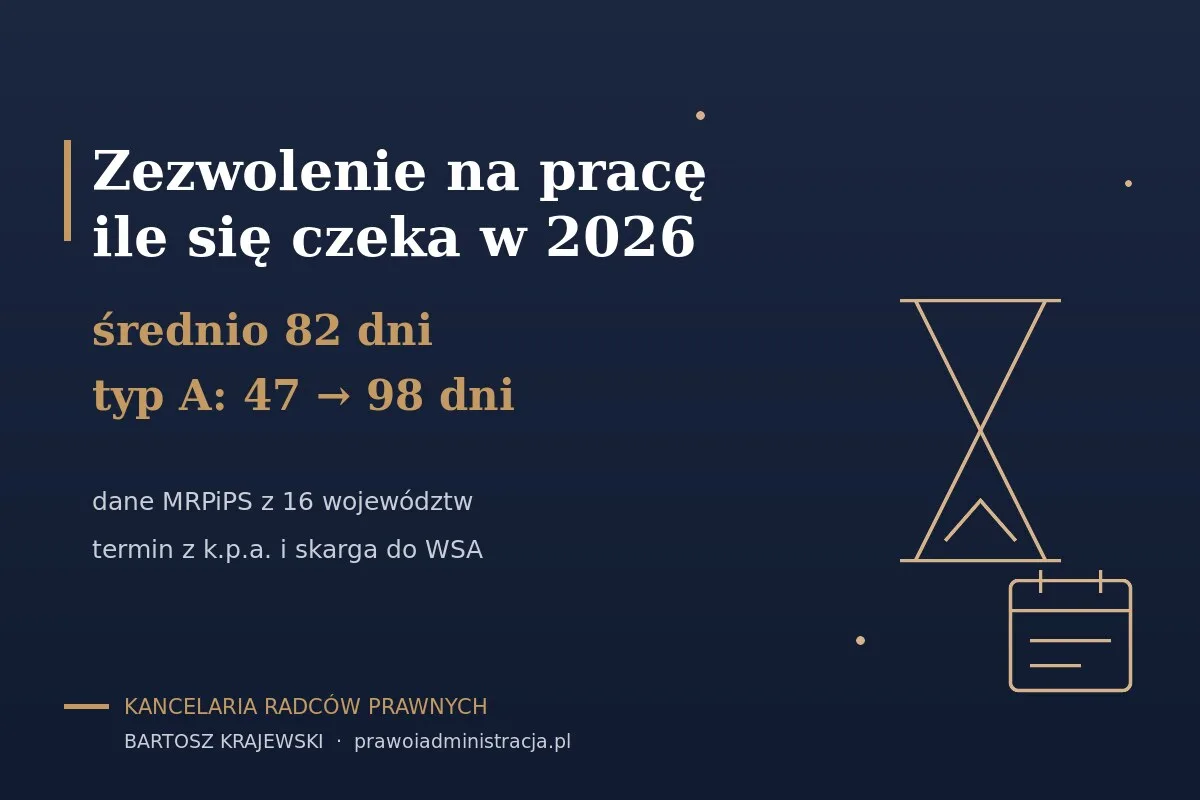
How long does a work permit take in Poland in 2026? 82 days on average in 2025, data by region
82 days on average in 2025, type A up from 47 to 98 days, 9,400 permits for 24,500 applications in seven months of 2026 at the Masovian office. Ministry data, a regional table, the legal deadline and what an employer can do once it has passed.
Read more →
Work permit in Warsaw (Masovian office) 2026: waiting times, how the case runs and a complaint to the WSA
The Masovian Voivodeship Office issues 22% of Poland's work permits and in 2026 it is issuing far fewer. We explain which department handles the case, how the procedure runs, what delay means for an employer and what 452 Warsaw WSA judgments show.
Read more →