Permanent residence in Poland 2026 — who qualifies, documents and the PLN 640 fee
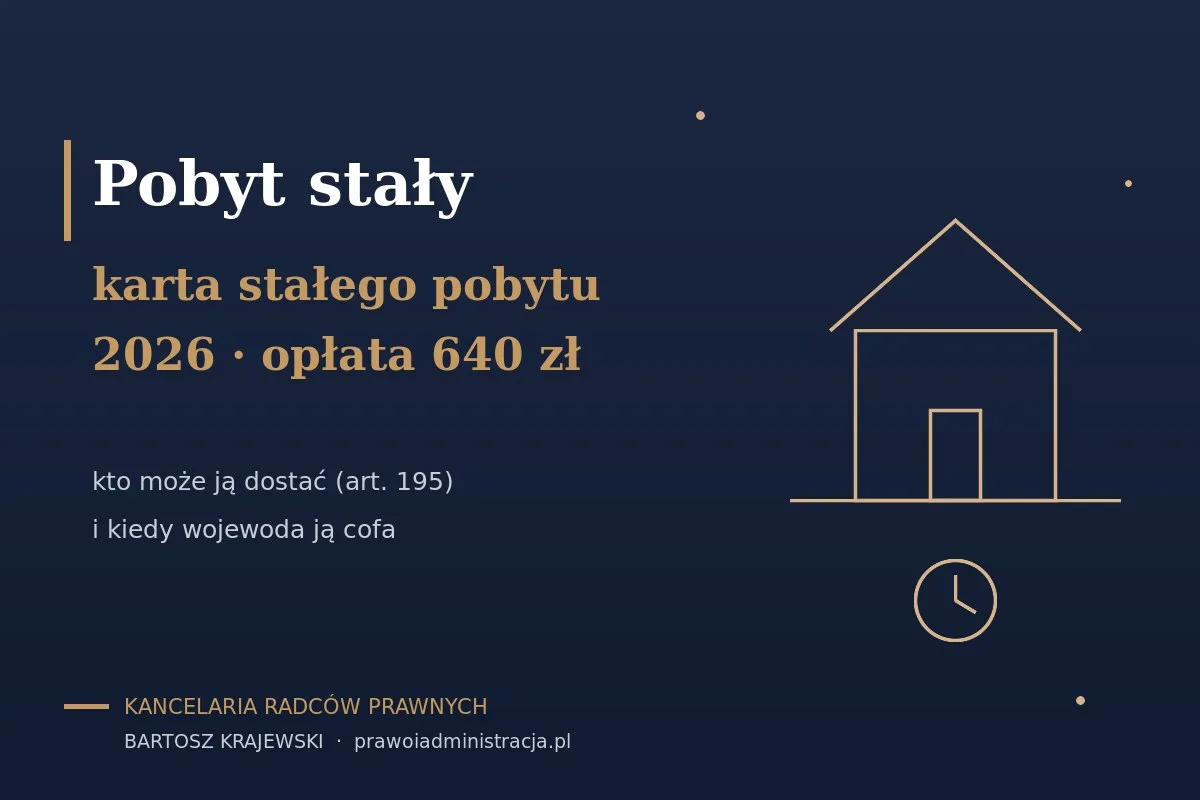
A permanent residence permit is granted for an indefinite period, but not to everyone — the Act lists a closed catalogue of people who may apply. A few years of work in Poland are not enough: what counts is Polish descent, the Karta Polaka, marriage to a Polish citizen or international protection. The fee is PLN 640, the voivode has 6 months to decide, and a single mistake in calculating continuous residence ends in a refusal. If you want us to check your basis and handle the application, see our online legalisation of stay.
What permanent residence gives you and how it differs from a temporary residence card
A permanent residence permit is granted for an indefinite period. It does not need renewing, it is not tied to an employer or a university, and it gives full access to the labour market — you work on the same terms as a Polish citizen, without a work permit and without notifying the voivode of every change of contract. You can also run a business on the terms that apply to Poles.
After the decision the voivode issues a residence card valid for 10 years. That is the validity of the plastic, not of the permit: after 10 years you exchange the card, with no new proceedings and no need to prove your basis again. The permit lasts until it is revoked or expires — by law it expires on the day you acquire Polish citizenship or EU long-term resident status (Article 200 of the Act on Foreigners).
Who can get a permanent residence card — the catalogue in Article 195
Article 195(1) of the Act on Foreigners lists the people to whom the voivode grants a permanent residence permit. If you do not fall into any of these groups, the application has no chance — however long you have lived in Poland:
- a child of a Polish citizen under that citizen’s parental authority, and a child of a foreigner with permanent residence or EU long-term resident status, born after the parent received that permit or during the parent’s legal stay in Poland
- a person of Polish descent who intends to settle in Poland permanently — at least one parent or grandparent, or two great-grandparents, of Polish nationality and a documented connection with Polishness
- a holder of a valid Karta Polaka who intends to settle in Poland permanently — with no prior-stay requirement and no stamp duty
- the spouse of a Polish citizen — after at least 3 years of marriage and 2 years of continuous stay on a temporary residence permit granted on the basis of that marriage
- a foreigner after 5 years of continuous stay with refugee status, subsidiary protection or a humanitarian stay permit, after 10 years on a tolerated stay permit under Article 351 points 1 or 3, and a person who has been granted asylum
- a victim of human trafficking cooperating with law enforcement, and a UK citizen who worked in Poland as a posted worker until 31 December 2020
The law also provides for permanent residence after 4 years of work in an occupation desirable for the Polish economy (Article 195(1)(6)(c)), but this route does not work yet — the regulation listing such occupations has not been issued. Ukrainian citizens under temporary protection may apply if they belong to one of the groups above; temporary protection itself does not block the proceedings.
Spouse of a Polish citizen — the most common basis and the most common refusal
Marrying a Polish citizen does not give permanent residence straight away. Both conditions must be met together: the marriage has lasted at least 3 years before the application, and immediately before applying you have lived in Poland continuously for at least 2 years on a temporary residence permit granted because of that marriage or because of refugee status, subsidiary protection or a humanitarian permit. Years spent on a card for work or studies do not count.
Your stay is continuous if no single break exceeded 6 months and all breaks together did not exceed 10 months. The office counts this from passport stamps and border data, and also checks whether the marriage is genuine. There is a consequence for the future too: if you divorce within 2 years of the permit being granted, the voivode may revoke it (Article 199(3)).
Applying through MOS, fees and how long the decision takes
Since 27 April 2026 the permanent residence application is filed only electronically in the Case Handling Module (MOS), signed with a trusted profile or a qualified signature. The key numbers:
- the application must be filed during your legal stay in Poland — it cannot be filed from abroad, and if filed on time it extends your legal stay until the decision becomes final
- the stamp duty is PLN 640, paid when you apply; Karta Polaka holders and people with asylum are exempt
- the residence card costs PLN 100, paid only after a positive decision
- the voivode has 6 months to decide (Article 210(1)), and the Head of the Office for Foreigners has 90 days to hear an appeal
The application must include a passport scan, a digital photo and evidence of your basis: the Karta Polaka, proof of Polish descent, a marriage certificate and the spouse’s ID card, documents explaining breaks in your stay. Foreign-language documents need a sworn translation. After you submit, the office summons you to give fingerprints, and asks for originals with a deadline of at least 14 days. Formal defects left uncorrected mean the application is left unexamined, and missing evidence means a refusal.
Permanent residence or EU long-term resident
These are two different permits that are often confused. EU long-term resident status comes after 5 years of legal stay, with a stable income, health insurance and Polish at B1 level — the route for most people who have simply worked in Poland for years. Permanent residence requires no Polish exam and — except for spouses and protection beneficiaries — no qualifying period, but it is open only to the groups in Article 195. You also cannot apply for permanent residence if you already hold EU resident status. We compare both routes in our article EU long-term resident — what it gives you.
Permanent residence also shortens the road to citizenship: under the current Polish Citizenship Act you can apply for recognition as a Polish citizen after 3 years of continuous stay on this permit, the spouse of a Polish citizen after 2 years, and a person with the Karta Polaka or Polish descent after just one year. The conditions and the PLN 1,000 fee are described in our article Polish citizenship 2026.
Travelling abroad and when the voivode revokes permanent residence
With a permanent residence card you can travel within the Schengen area for up to 90 days in any 180-day period and visit your home country without limits. Ordinary trips do not cost you the permit, but Article 199 of the Act on Foreigners lists the situations in which the voivode revokes it:
- leaving Poland for a period exceeding 6 years
- a final conviction in Poland for an intentional offence with a sentence of at least 3 years’ imprisonment
- false data, forged documents or concealing the truth in the permit proceedings, as well as reasons of defence, state security and public order
- a divorce within 2 years of the permit being granted, if the permit was based on marriage to a Polish citizen
A decision refusing or revoking the permit can be appealed to the Head of the Office for Foreigners, through the voivode, within 14 days of service. Once the decision is final and you have no other basis of stay, you must leave Poland within 30 days. What makes an appeal effective is explained in our guide residence card refusal — appeal.
How we handle a permanent residence case and what it costs
We start by checking whether, and on what basis, you are entitled to permanent residence, and by counting the breaks in your stay from your passport — this is where most refusals are decided. Then we gather the evidence, prepare the MOS application so that you only need to sign it and send it from your own account, and handle the proceedings until the decision: we answer summonses, watch the deadlines and file a reminder (ponaglenie) if the office delays. Handling a permanent residence case costs PLN 2,200, and in our online legalisation mode PLN 1,900 at the promotional price. Official fees — PLN 640 for the application and PLN 100 for the card — are separate.
Kancelaria Radców Prawnych Bartosz Krajewski handles residence cases before the Masovian voivode in Warsaw and remotely before offices across Poland. If you would rather talk first, book a consultation on the page foreigners’ cases in Warsaw.
Frequently asked questions
Who can get a permanent residence card in Poland?
Will I get permanent residence after 5 years of work in Poland?
How much does permanent residence cost and how long does it take?
Can I travel abroad with a permanent residence card?
Does the permanent residence card expire after 10 years?
Which is better: the EU resident card or the permanent residence card?
Related articles
EU Long-Term Resident in Poland — What the Card Gives You and Who Qualifies (2026)
The EU long-term resident card means indefinite stay, work without a permit and a pass to other EU countries. We explain who can get it, what it costs, when you lose it and how it differs from permanent residence.
Read more →
Polish Citizenship in 2026 — the Reforms and the 1000 PLN Fee
The Sejm has rejected the bill extending the required residence from 3 to 10 years, but the Ministry of the Interior (MSWiA) is announcing its own amendment: 8 years of residence and a state exam. The current, favourable rules still apply — anyone who meets the conditions should not put off filing.
Read more →
Family Reunification in Poland — Joining a Spouse, Child or Parent in 2026
Spouse, child or parent of a foreigner in Poland — when and under what conditions can a family reunite. We explain the sponsor's 2-year residence condition, the age rules for children, and the difference between joining a Polish citizen and joining a foreigner.
Read more →
Can You Leave Poland While Your Residence Card Application Is Pending? The Certificate Is Not a Visa
The costliest myth in foreigners' cases: "I have the stamp, so I can leave and come back". A certificate of filing an application protects your stay in Poland, but it does not open the border. We explain what you may actually do, and what leaves you stranded abroad.
Read more →